Business travel has changed. The best luxury city hotels for business travelers and executives are no longer judged only by star ratings or central addresses. Today, executive travelers want a complete urban hospitality experience that supports productivity, privacy, wellness, premium dining, fast ground access, and polished service. A great business hotel must work as a temporary office, a private retreat, and a refined venue for client meetings, all at the same time. In 2025, The World’s 50 Best Hotels named Rosewood Hong Kong the world’s best hotel, while Forbes Travel Guide’s 2026 Star Awards continued to recognize leading luxury properties through its independent rating system. Those benchmarks help identify city hotels that combine prestige with real-world performance for premium travelers.
For executives, the ideal city hotel often delivers something more specific than general luxury. It needs strong business infrastructure, discreet service, excellent location planning, comfortable suites, reliable transport access, and a calm environment after long meetings or long-haul flights. That is why some of the world’s top luxury urban hotels stand out not just for beauty, but for how well they support demanding schedules. Hotels such as Rosewood Hong Kong, Four Seasons Hotel Bangkok at Chao Phraya River, Mandarin Oriental Hong Kong, The Peninsula Tokyo, and Four Seasons Hotel George V Paris all belong in the conversation because they combine luxury credibility with features that matter to business-focused guests.
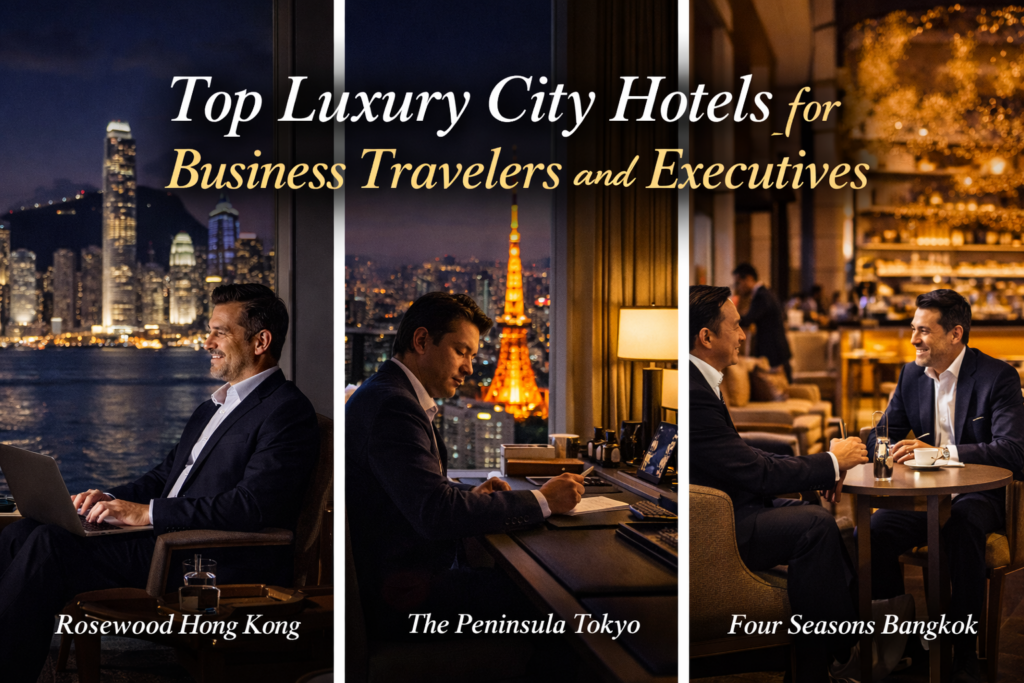
Why Luxury City Hotels Matter for Business Travelers
Luxury city hotels matter because business travel is often compressed, stressful, and high stakes. Executives may arrive after overnight flights, move directly into meetings, host clients over dinner, and need a seamless workspace before leaving for another city the next morning. In that context, a hotel room is not only a place to sleep. It becomes a private office, a meeting preparation zone, and a recovery environment. The best luxury city hotels for business travelers and executives understand that pressure and reduce friction at every point of the stay.
Location is especially important. A luxury resort can compensate for remoteness with scenery, but a city business hotel must win through access. Hotels in major financial or diplomatic districts, or with efficient airport connections, tend to perform better for executive use. The best properties also add business-friendly support through concierge precision, late-night dining, quiet lounges, strong wellness facilities, and well-designed suites that help guests shift between work mode and rest mode. That combination is what turns a luxury hotel into a true executive hotel.
What Makes a Luxury City Hotel Ideal for Executives
The first element is service consistency. Business travelers cannot afford uncertainty. They need early check-ins when possible, dependable housekeeping, prompt luggage handling, discreet staff, and efficient problem solving. Forbes Travel Guide emphasizes that its inspectors evaluate properties using up to 900 objective criteria, which is useful because it reflects how deeply service execution matters at the top end of hospitality. A beautiful lobby may create a strong first impression, but elite business travelers remember whether the hotel handled the small operational details well.
The second element is room and suite functionality. Executives need more than attractive decor. They need strong desks, comfortable seating, quiet layouts, reliable internet, quality bedding, and enough privacy to take calls or prepare for presentations. In premium city hotels, this often means larger rooms, better sound insulation, and more polished in-room dining than what is found in standard corporate hotels. For business travelers staying several nights, these features become essential, not optional.
The third element is the hotel ecosystem. A strong executive hotel offers more than a room. It may include high-level dining, refined bars for informal meetings, club lounges, wellness spaces, chauffeur support, and a lobby environment suitable for client interaction. The best city hotels act as business platforms inside luxury settings. That is why global urban icons continue to appeal to executives even as remote work and hybrid schedules reshape travel patterns.
Rosewood Hong Kong: World-Class Urban Luxury for Global Executives
Rosewood Hong Kong is one of the strongest current examples of a luxury city hotel that can serve executives extremely well. The World’s 50 Best Hotels named it the world’s best hotel for 2025, and Rosewood’s own press materials describe it as rising 43 stories above Victoria Harbour with 12 restaurants and lounges, the Asaya well-being concept, and the exclusive Manor Club. Those details matter because they show the property is not only visually impressive but also operationally broad enough to support business travelers with dining variety, wellness access, and premium social spaces.
For executives, Hong Kong remains one of the world’s most strategic urban destinations, and Rosewood’s harborfront positioning adds prestige as well as practical access. A hotel like this works because it can support formal meetings, discreet entertaining, and recovery after long-haul travel. The presence of multiple restaurants and lounges is especially useful for business travelers who need flexibility for breakfasts, working lunches, or evening client dinners without leaving the property.
Rosewood Hong Kong also reflects the modern direction of executive luxury. It is design-driven, polished, and experience-rich, but it is not dependent on old-fashioned business hotel formulas. For travelers who want a refined urban base that feels globally relevant and visually current, Rosewood Hong Kong is one of the best luxury city hotels for business travelers and executives today.
Four Seasons Hotel Bangkok at Chao Phraya River: Executive Calm in a Major Asian Hub
Four Seasons Hotel Bangkok at Chao Phraya River is another highly relevant option for executive travelers. Bangkok is both a major regional business gateway and a city where hotel quality can significantly affect the travel experience because of traffic, climate, and scheduling intensity. A highly functional luxury hotel can make business trips there far more efficient and comfortable.
What makes this property appealing for executives is the balance between city access and atmosphere. Business travelers often want a hotel that feels calm without becoming inconveniently detached. Four Seasons hotels generally perform well for this audience because they combine strong service systems with highly polished rooms, credible dining, and dependable concierge support. In a city like Bangkok, where meetings, client dinners, and airport transfers can shape the day as much as the room itself, that reliability matters.
For executives doing regional travel across Asia, Bangkok is often a hub rather than a final destination. That makes the hotel’s ability to support quick turnarounds, executive comfort, and evening decompression especially important. Four Seasons Hotel Bangkok at Chao Phraya River stands out because it offers luxury without sacrificing practical usability for serious travelers.
Mandarin Oriental Hong Kong: Traditional Executive Prestige
Mandarin Oriental remains one of the classic names in luxury urban hospitality. The group’s 2025 press information describes Mandarin Oriental as an award-winning operator of some of the world’s most prestigious hotels and notes its history growing from original flagship properties in Hong Kong and Bangkok into major business centers and key leisure destinations. That description is especially relevant for business travelers, because it highlights the brand’s longstanding focus on major urban centers rather than purely leisure settings.
Mandarin Oriental Hong Kong has enduring appeal for executives because it represents a more traditional model of business luxury. It is associated with formal service, a strong urban base, and brand heritage that many experienced business travelers still value. In a market increasingly filled with lifestyle-led luxury, Mandarin Oriental keeps its relevance by emphasizing precision, polish, and a reputation built over decades. That kind of continuity can be very appealing for executives who want a hotel that feels proven rather than experimental.
Another strength is brand alignment. Executives who travel frequently often prefer hotel groups that maintain similar standards across multiple cities. Mandarin Oriental’s positioning in major business centers makes it especially useful for travelers whose schedules include repeated stays in financial and diplomatic capitals. That consistency is a major asset in executive travel planning.
The Peninsula Tokyo: Refined Service for High-Level Business Travel
The Peninsula brand is well established in the city-hotel segment, and its Manila property was named Best City Hotel in Manila by Business Traveller Asia-Pacific in 2024. While that specific award applies to Manila, it supports the broader point that Peninsula properties remain highly credible in the premium city hotel category. For executives, The Peninsula Tokyo stands out because Tokyo requires precision. It is one of the world’s most demanding business cities, and hotels there need to match that rhythm with exceptional service, polished logistics, and calm interiors.
Peninsula hotels are especially attractive to executives who value formal hospitality and smooth operational support. That can include well-handled transfers, strong concierge coordination, and quiet, elegant public spaces suitable for informal conversations. In a city where professionalism and detail matter enormously, a Peninsula hotel fits naturally into the expectations of premium business travel.
Tokyo also rewards hotels that can provide emotional relief from the speed of the city. Executives often need a hotel that feels serene without becoming sterile. Peninsula’s style tends to deliver that balance well. It is polished and luxurious, but still warm enough to support longer stays and repeated visits.
Four Seasons Hotel George V Paris: Luxury for Executives Who Entertain
Not every business trip is purely transactional. Some executive stays involve relationship building, client entertainment, brand positioning, or luxury-facing industries such as finance, fashion, consulting, private aviation, and hospitality itself. In those cases, a hotel like Four Seasons Hotel George V Paris becomes highly relevant. Four Seasons describes the property as being in Paris’s Golden Triangle and notes its three restaurants holding six Michelin stars among them. That matters because executive travel at the top end often includes social and culinary settings as part of business activity.
A hotel like George V works for executives because it combines location prestige with service depth. It can function as a place to stay, but also as a place to host. Strong dining inside the hotel reduces planning friction and allows high-level meetings or dinners to happen within a controlled, beautiful environment. For leaders in client-facing industries, that can be as valuable as a boardroom.
Paris is also a city where image and setting can matter in business contexts. For executives hosting partners or representing premium brands, a globally respected hotel address adds soft power to the trip. That is one reason iconic urban luxury hotels continue to matter so much in executive travel.
Why Club Access, Dining, and Wellness Matter More Than Ever
The best luxury city hotels for business travelers and executives now compete as much on experience ecosystems as on rooms. Club floors, executive lounges, premium bars, flexible dining, and strong wellness programming all matter because they help travelers manage energy and time. Rosewood Hong Kong’s Manor Club and Asaya well-being concept are good examples of how a hotel can extend beyond accommodation into a broader executive support environment.
Wellness has become especially important. Business travelers used to accept fatigue as part of the job, but top hotels now market better sleep, spa access, fitness quality, and recovery-focused services as key premium features. This matters because executives are not only buying luxury. They are buying performance support. A hotel that helps a guest recover quickly after a flight may be more valuable than one that simply looks impressive in photographs.
Dining quality matters for similar reasons. In a luxury business hotel, breakfast must be efficient, in-room dining must be dependable, and evening venues must feel suitable for different levels of formality. Hotels that can handle all of those moments inside one property reduce decision fatigue and strengthen the overall executive experience.
How Executives Should Choose the Right Luxury City Hotel
The right hotel depends on the type of business traveler. Some executives need a formal, heritage-style hotel with flawless service and quiet prestige. Others prefer a modern, design-led hotel with flexible public spaces and a more contemporary atmosphere. Travelers focused on Asia-Pacific business circuits may prioritize Hong Kong, Bangkok, Tokyo, and Singapore properties, while Europe-facing executives may care more about Paris, London, or Zurich. Forbes Travel Guide’s destination and awards framework is useful because it confirms which luxury hotels continue to perform at elite levels across major cities.
Travelers should also match the hotel to the purpose of the trip. If the stay involves entertaining and image, a grand flagship hotel may be best. If the trip is compressed and operational, a calmer property with superb room comfort and wellness access may matter more. Executive travel works best when the hotel choice is strategic, not generic.
Final Thoughts
The top luxury city hotels for business travelers and executives combine prestige with performance. The strongest properties support real business needs through service consistency, executive-friendly rooms, location logic, excellent dining, and spaces that allow guests to move naturally between work and rest. Current global recognition suggests that hotels such as Rosewood Hong Kong and Four Seasons Hotel Bangkok at Chao Phraya River belong near the top of this category, while enduring city brands such as Mandarin Oriental and Peninsula remain deeply relevant for executive travelers who value precision and trust.
For today’s premium traveler, the best city hotel is not simply the most luxurious one. It is the one that makes a demanding trip feel controlled, efficient, and elevated from arrival to departure. That is the real standard for executive luxury hospitality.